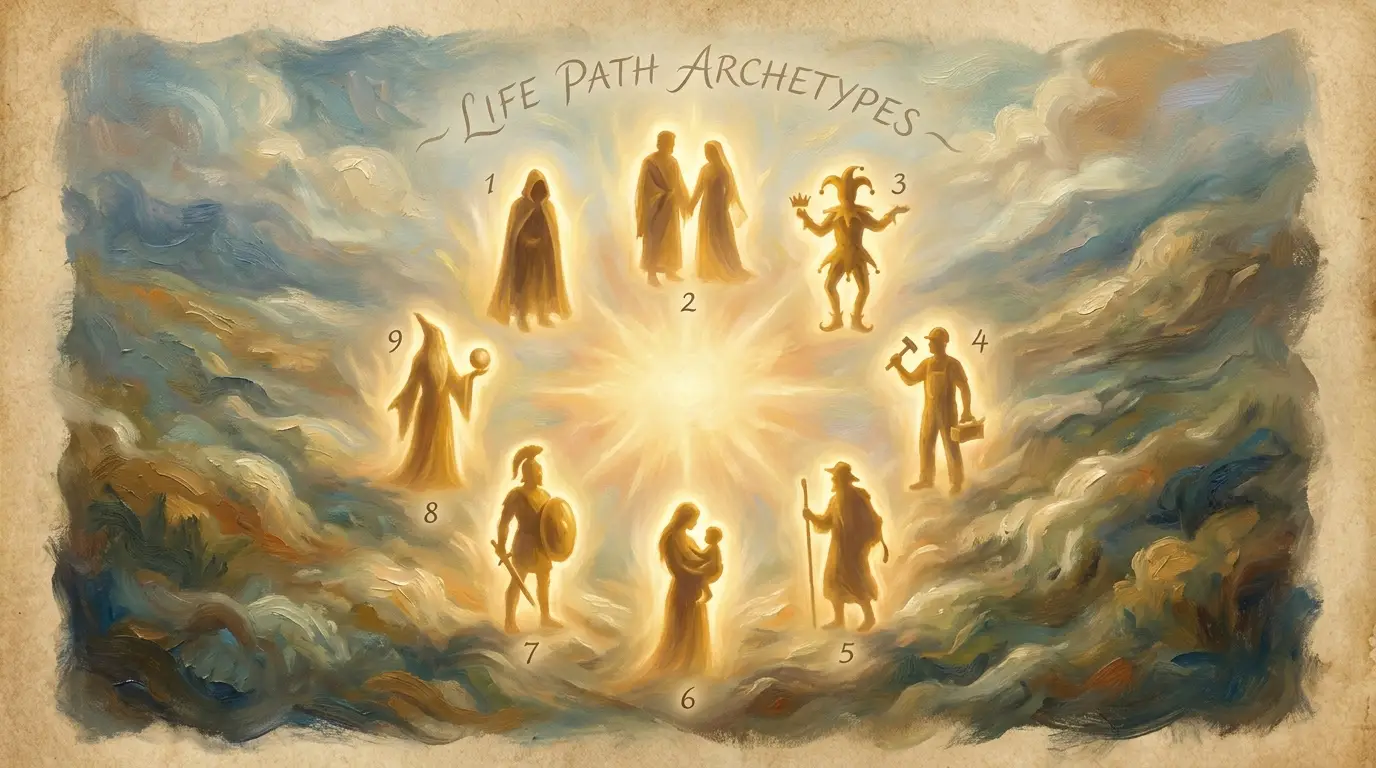
What a Life Path Number Actually Is
Your life path number is the single most important number in a standard numerology chart. It is derived from your date of birth, reduces down to one digit between 1 and 9 in most cases, and is meant to describe the overarching theme of the life you are here to live. Numerologists in the Pythagorean tradition treat it as roughly analogous to the sun sign in Western astrology — the anchor point everything else is read against — although the underlying claim is a bit different. Where the sun sign tries to describe personality expression, life path tries to describe purpose: the lessons you are most likely to keep meeting, the strengths you are wired to develop, and the shape of the arc you are walking across decades.
It is important, right at the start, to be honest about what kind of tool this is. Numerology is a symbolic framework, not an empirical science. No peer-reviewed study has ever demonstrated that your birth date produces measurable, repeatable personality effects. What the tradition offers instead is a compact vocabulary — nine base themes plus three amplified master numbers — for thinking about your own tendencies. Used well, that vocabulary can help you catch patterns you already have, name things you already suspect, and choose more deliberate responses to situations that keep repeating. Used badly, it becomes a way to hand your agency to a two-digit sum.
The life path number sits inside a larger family of core numbers, and understanding that family helps you avoid overreading any single one. Alongside life path you will find the expression or destiny number (from your full birth name), the soul urge or heart's desire number (from the vowels in your name), the personality number (from the consonants), and the birthday number (just the day of the month you were born). Each answers a different question. Life path answers the biggest one: what is this whole thing about, at the level of decades? That is why it usually gets read first and why entire schools of numerology essentially organise their teaching around it.
For readers using the Raka app, the life path number is auto-calculated the moment you enter a birth date, and it becomes the backbone of every subsequent reading in the app. The AI reading coach will refer back to it when you ask about a specific tarot spread. The 90-lesson course inside Raka teaches you to interpret it alongside your natal chart. And the numerology tools cross-reference it with your personal year and personal month numbers so you can see how a lifelong theme is expressing itself in a particular season. Even outside the app, though, the calculation is simple enough to do on paper — which is what the next section covers.
How to Calculate Your Life Path Number??????
The calculation is deliberately simple. Write your birth date in month, day, and year form. Add every single digit together. If the total has more than one digit, add those digits together too. Keep reducing until you have a single digit — with one exception, which we will get to in a moment. That single digit is your life path number, and it will stay the same for the rest of your life. Nothing you do, no name change, no move, no marriage, changes what your birth date is, so the number itself is a fixed input rather than something that shifts with circumstance. Part of our number symbolism library.
Related: Pisces lucky numbers
Let us walk through an example. Take a birthday of March 14, 1990. That is 3 for the month, 1 and 4 for the day, and 1, 9, 9, 0 for the year. Add them: 3 + 1 + 4 + 1 + 9 + 9 + 0 = 27. Now reduce: 2 + 7 = 9. That person has a life path 9. Another example: December 2, 1988. That is 1 + 2 + 0 + 2 + 1 + 9 + 8 + 8 = 31. Reduce: 3 + 1 = 4. Life path 4. Notice how straightforward the arithmetic is — this is deliberate. Numerology is meant to be accessible without specialist software or ephemerides, which is one reason it spread so widely in the modern self-help tradition. Part of our number symbolism library.
The one crucial exception is master numbers. If your sum at any stage lands exactly on 11, 22, or 33, you stop reducing. Those three totals are treated as master numbers with amplified themes, and they are left in their two-digit form. So a birth date summing to 29 keeps going (2 + 9 = 11 — stop, that is master 11), while a date summing to 21 becomes life path 3. Some older texts still reduce master numbers all the way down; the mainstream modern convention, which is what the Raka app uses, is to hold them. If you land on a master number, you are read as both that master and its reduced form — for example, 22/4 — because the underlying themes still rhyme with the base digit.
A few practical points that trip people up. First, use your actual birth date, not the date on any document that might disagree with it — the number is symbolic of the moment you entered the world. Second, do not shortcut by reducing month, day, and year separately before adding; some numerologists do it that way and get slightly different master-number results, but the safest general method is the straight all-digit sum described above. Third, do not include the time, place, or any other factor. Life path only cares about the calendar date. That is why, unlike a natal astrology chart, it works even for people who have no idea what time they were born.
Master Numbers: 11, 22, and 33
Master numbers occupy a special category in modern Pythagorean numerology. Three of them are recognised: 11, 22, and 33. When your date-of-birth sum lands on any of these without needing further reduction, you keep the two-digit form. The idea is that the doubled digit intensifies the underlying vibration — 11 as an amplified 2, 22 as an amplified 4, 33 as an amplified 6 — and that the person walking that path is signed up for a more demanding, higher-stakes version of the same core themes. Master status is not a promotion. If anything, it usually means the base themes will feel harder to integrate for longer.
Life path 11 is often described as the intuitive or the inspirer. Where 2 is about partnership, sensitivity, and diplomacy, 11 pulls those qualities into service of a bigger vision. People on this path frequently report feeling other people's emotions unusually strongly, being pulled toward teaching or healing work, and struggling with anxiety when their nervous system gets overloaded. The developmental task is learning to hold the intuitive channel open without burning out. Many life path 11s spend their twenties trying to be a normal 2 — quiet, supportive, in the background — before waking up in their thirties to a stronger sense of what they came here to say.
Life path 22 is called the master builder. It is 4 (the number of structure, work, and reliability) amplified into a capacity to build lasting institutions, businesses, or systems that outlive the builder. This is the path of the person who wants to leave something concrete behind — a company, a body of work, a movement — rather than just a good reputation. The shadow is grandiosity or, more commonly, the opposite: fear of the size of the vision, followed by decades of playing small. Many 22s do their most important work after forty, once they finally accept that they are not going to be talked out of the scale of what they are here to construct.
Life path 33 is the rarest of the three and is sometimes called the master teacher. It is 6 (nurture, service, family) turned outward into large-scale caretaking work: education, ministry, medicine, movement leadership, deep community service. Very few birth dates sum to 33 without reducing further, which is one reason it is treated with a slightly awed tone in the literature. The risk on this path is martyrdom — giving so completely that the giver disappears — and the developmental task is learning that sustainable service requires a sustainable self. Not everyone romantic about being a 33 actually wants to live the daily obligations of one.
Life Path 1: The Initiator
Life path 1 is the path of the initiator, the leader, and the individual who is here to develop an unmistakable sense of self. If you are a 1, the through-line of your life is likely to be repeated invitations to stand at the front — to start the project, make the call nobody else will make, and take responsibility for outcomes even when the group would rather not. Numerologically, 1 is the seed number: everything else in the sequence unfolds from it. That is a fitting image, because 1s tend to be the ones who kick things into motion and then move on before the harvest. Part of our number symbolism library.
The strengths of a well-lived 1 are obvious. Initiative. Decisiveness. A willingness to be first, to be misunderstood, to be alone with a decision. These are the people who found companies, launch movements, and refuse to sit still in structures that no longer fit. Their gift is a kind of courageous forward motion that other numbers can benefit from being near. When a 1 is aligned, people around them find themselves starting things they had been postponing for years — sometimes because the 1 asked, sometimes just by contagion. Part of our number symbolism library. Part of our number symbolism library.
The shadows are equally recognisable. Domination. Impatience with people who need more time to arrive at a decision. A tendency to interpret every disagreement as an attack on their autonomy. Left unexamined, a 1 can spend a whole decade winning arguments and losing relationships. The developmental task is learning that leading is not the same as controlling, and that other people's slowness is often information rather than an obstacle. Many 1s learn this the hard way — by pushing through, arriving somewhere, and finding they got there alone.
If you are a 1 and you are using Raka, the AI reading coach will often surface prompts about where you might be leading without being asked to, or where you are quietly refusing to follow someone else's initiative. Pair the life path with the 3-card decision spread in the app when you are debating a career move; the friction between the theme of 1 (go, now, alone) and the more nuanced pull of a spread often produces the most useful reflection. The point is not to override the 1 tendency but to see it working in real time.
Life Paths 2 and 3: The Partner and the Communicator
Life path 2 is the counterweight to 1. Where 1 initiates alone, 2 shows up in relationship — as partner, mediator, collaborator, and reader of the emotional undercurrent in a room. The core lesson is that softness and receptivity are strengths, not deficits, and that a great deal of important human work happens through diplomacy rather than declaration. Well-lived 2s often anchor teams, marriages, and communities by being the person who notices before anyone else that something is off and who can name it without escalating it. Their instinct is toward pairing, and life will keep bringing them into partnerships that ask them to hold that stance without losing themselves.
The shadow of 2 is the loss of self inside the partnership. It shows up as chronic people-pleasing, resentment that never gets voiced, and an outsized fear of conflict. Two-path people can spend years subordinating their preferences to the loudest person in the room and then wonder why their life feels like someone else's. The developmental task is learning to bring your own weight into the pairing without abandoning the collaborative gift. That often means saying the hard thing once, cleanly, and letting the other person adjust — an act of love, not war.
Life path 3 is the communicator, the creative, and the entertainer. It is a path organised around expression: through language, art, humour, music, or the sheer social alchemy of getting a room laughing. Three-path people tend to have more channels open than the average human — they feel more, associate more, connect more — and their lifelong task is to give that abundance a form. When it works, they become the person who translates hard truths into stories other people can actually hear. When it does not, the same energy scatters into a hundred half-finished projects and a persistent sense that they are wasting themselves.
The shadow of 3 is dilettantism, superficiality, and a use of charm as armour. Because three-path people are often naturally likeable, they can coast on charisma for a long time before being asked to produce something serious. The developmental task is to choose one or two channels and go deep — to accept the discipline that turns a talented person into a body of work. Numerologically, 3 is closely tied to creativity as a life force, so when a 3 is blocked creatively, they usually feel it as a low-grade depression they cannot explain. The prescription is almost always the same: make something, ship it, and repeat.
Life Paths 4 and 5: The Builder and the Freedom Seeker
Life path 4 is the builder. It is the number of structure, patience, craft, and steady work done over long horizons. Four-path people are the ones who show up every day, do the unglamorous piece, and end up with something durable to point to at the end. Their gift is reliability in a culture that constantly rewards spectacle over consistency. Numerologically, 4 corresponds to the square — the most stable geometric form — and the same feeling runs through the personality: grounded, sometimes stubborn, resistant to fads, oriented toward what will still be here in twenty years.
The shadow of 4 is rigidity. When the builder tendency is not balanced, it becomes an inability to adapt, an obsession with correct procedure, and a suspicion of anything that cannot be measured. Four-path people can also carry a heavy relationship to work — treating rest as a moral failure and burnout as evidence of virtue. The developmental task is to learn that structure exists to serve life, not the other way around, and that flexibility is not the same as flakiness. Master number 22 is the amplified version of 4, and it often carries the same lessons at a larger scale.
Life path 5 is the opposite pole: freedom, motion, appetite, and experience. Five-path people are wired for change. They tend to have wide interests, get restless in confined roles, and metabolise novelty like other people metabolise sleep. When it works, they become the person who has actually lived enough to be interesting — the friend who has done six careers, three countries, and every conversation topic. Their gift is a kind of embodied curiosity that keeps everyone around them from calcifying.
The shadow of 5 is scattering. Without discipline, the same energy that produces a rich life produces a chaotic one: relationships walked away from at the first sign of routine, addictions used to keep the nervous system moving, decades of horizontal motion with no vertical growth. The developmental task is not to suppress the freedom drive but to learn that real freedom includes the freedom to stay — to choose commitment consciously rather than being controlled by fear of it. Many 5s only become themselves fully when they finally build something they refuse to walk away from.
Life Paths 6 and 7: The Nurturer and the Seeker
Life path 6 is the nurturer, the caretaker, and the person for whom love and responsibility are basically the same word. Six-path people tend to organise their lives around the people and communities they take care of — biological family, chosen family, teams, patients, students. Their gift is a capacity for sustained care that most numbers cannot match. When it works, they become the emotional load-bearing wall of everything they are part of, and other people build entire lives against that stability. Master number 33 is the amplified version of 6, and it takes the same themes into public-facing service work.
The shadow of 6 is martyrdom and control disguised as care. When the nurturer instinct is not balanced with a strong sense of self, six-path people can end up doing everything for everyone, resenting all of it, and using caretaking as a way to stay indispensable. They can also mistake managing other people's lives for loving them. The developmental task is to learn that real care includes letting the other person be responsible for themselves, and that you cannot pour cleanly from a resentful container. Many 6s do their most important inner work by learning to accept care from others.
Life path 7 is the seeker — the mystic, researcher, analyst, and quiet observer. Seven-path people are wired for depth. They tend to need more solitude than average, ask questions the rest of the group has stopped asking, and gravitate toward specialised knowledge, spirituality, or intellectually demanding work. Their gift is a willingness to sit with a question long enough to hear a real answer, in a culture that mostly wants quick ones. When a 7 is aligned, they become the person you go to when you need the truth rather than the reassurance.
The shadow of 7 is isolation and superiority. Left unchecked, the same depth that produces insight can produce a life that is entirely inside the seven-path person's own head, cut off from the messiness of ordinary relationships and quietly convinced that everyone else is shallow. Seven-path people can also use spirituality as a bypass — collecting frameworks so they never have to feel anything directly. The developmental task is learning to bring the depth back into contact: to let a real relationship interrupt the analysis, and to trust that vulnerability is not a lower form of knowing than thought.
Life Paths 8 and 9: The Executive and the Humanitarian
Life path 8 is the executive. It is the path of power, money, ambition, and the material plane — a number that is unapologetically interested in building, running, and leveraging worldly structures. Eight-path people are here to develop a mature relationship with authority, both their own and other people's. Numerologically, 8 is the number of cycles and consequences: the loop of cause and effect, effort and reward, mistake and correction. Well-lived 8s become the person who can hold real responsibility without shrinking from it and without abusing it, which is rarer than it sounds.
The shadow of 8 is the corruption of that same drive. Eight-path people can end up chasing status until it hollows them out, mistaking the score for the game, or using power to compensate for early experiences of powerlessness. They can also swing the other direction and refuse the power entirely — playing small out of a superstition that ambition is spiritually contaminated. The developmental task is to make peace with money and authority as neutral tools that take on the character of the person wielding them. Many 8s go through at least one major financial or professional collapse and rebuild before the lesson lands.
Life path 9 is the humanitarian, the old soul, and the number of completion. Nine sits at the end of the base sequence, and the personality often reflects that — a sense of having lived through this before, a natural pull toward the universal rather than the personal, and an instinct for endings and letting go. Nine-path people tend to organise their lives around service to something larger than themselves: a cause, an art, a community, a body of teaching. Their gift is perspective. They see the whole arc, and they can help other people zoom out from immediate pain.
The shadow of 9 is emotional distance and unresolved endings. Nine-path people can become so identified with the universal that they never fully arrive in their own particular life — never commit to this partner, this city, this specific practice. They can also carry unprocessed grief from earlier chapters they refused to properly close. The developmental task is to complete what actually needs completing, mourn what needs mourning, and let the humanitarian instinct grow out of a fully inhabited personal life rather than as a substitute for one. Many 9s become genuinely themselves only after they stop trying to be everyone's.
Life Path Number vs. Sun Sign: Different Questions
A lot of confusion comes from readers assuming life path and sun sign are two versions of the same thing. They are not. Your sun sign comes from where the Sun sat, in zodiac terms, on the day you were born. It is one component of a natal astrology chart, and it tries to describe personality expression — the flavour of ego, the default style you bring into a room. Life path, by contrast, comes from numerology and is derived from the sum of your entire birth date. It tries to describe the arc of a lifetime: lessons, tendencies, and the shape of the story you are here to live.
Because they come from different traditions, the two systems are not competing claims about the same thing. They are two different lenses. A Leo sun tells you something about how you show up socially. A life path 4 tells you something about the long-term structure you are trying to build. It is entirely coherent for those to describe the same person — a Leo 4 might be the charismatic front-of-house of a very disciplined long-range project. In practice, most experienced readers use both together and are careful not to force one to explain the other.
Where the two systems overlap is in the archetypal vocabulary they share. Both use small vocabularies of core types — twelve zodiac signs, nine or twelve numerology paths — to compress complex human experience into a few workable categories. Both risk the same failure mode: treating the category as the whole story and skipping the actual person in front of you. The healthiest use of either is as a starting question, not an ending answer. What does this Leo do with the Leo pattern? What does this life path 7 do with the seven pattern? That is where the interesting information lives.
Inside the Raka app the two systems are wired together deliberately. When you enter your birth date, the numerology engine gives you a life path number, and the natal chart engine gives you a full astrology chart — sun, moon, rising, planets, houses. The AI reading coach can then answer questions like, what does it mean that I am a life path 3 with a Capricorn sun? which is a much more useful question than either system alone can answer. The 90-lesson course teaches both alongside each other so you come out with a working vocabulary in both rather than a shallow familiarity with one.
What Life Path Really Means: Purpose vs. Personality
One of the most useful distinctions in numerology is between purpose and personality. Life path is a purpose number. It is trying to describe what your life is about at the level of decades — the themes you will keep meeting, the lessons that will keep coming back around, the shape of the story you are inside. It is not primarily a personality description. Two life path 5s can have wildly different personalities: one extroverted and reckless, one introverted and cautious. What they will share is the underlying arc — a life organised around freedom, motion, and the metabolisation of experience.
This matters because it protects you from a common mistake, which is reading a life path meaning, not recognising yourself in the surface description, and concluding either that the system is broken or that you are somehow doing your number wrong. Neither is usually true. Purpose can express through very different personalities, and the same person will express their life path differently at twenty than at fifty. The question is not whether the description sounds like you today. The question is whether the underlying theme keeps showing up when you look at the last ten or twenty years.
There is also a difference between the theme of a life and the events of a life. Life path 8 does not mean you will be rich. It means power, money, authority, and consequence will be recurring subjects, whether you become a CEO, a monk who refuses money on principle, or an accountant working through the trauma of a bankrupt parent. All three of those lives are recognisably 8-shaped. Numerology is a symbolic system, not an outcome predictor, and it fails badly the moment you try to use it as one. The Raka blog will keep hitting this point because it is the single most common misuse.
So the practical use of a life path number is not to tell you what will happen. It is to give you a stable frame for asking better questions about what is already happening. When you feel stuck, the question becomes: what does this stuck-ness look like inside my particular life path? When you make a big decision, the question becomes: does this move me deeper into the lessons my number is pointing at, or is it a detour? Those are questions any adult can answer for themselves. The number is just a way of making the conversation more precise.
Common Misconceptions About Life Path Numbers
The first misconception is that some life paths are better than others. They are not. Every base number in the system carries a full set of gifts and difficulties, and every master number carries an amplified version of both. Life path 8 is not luckier than life path 2, and life path 33 is not spiritually superior to life path 5. The tradition treats the numbers as different flavours of a full human life, not as a ranking. When people insist their number is a bad one, they are usually reacting to a shadow description and forgetting that the same digit also carries the corresponding strengths.

The second misconception is that your life path predicts specific events. It does not. Numerology, at its most honest, is a description of themes and tendencies. A life path 4 is not going to become an architect just because 4 is the number of structure. They might become an architect, or a nurse who runs a very tight ward, or a novelist with a rigorous daily writing practice. All of those are life-path-4 shaped lives. Any reader who tells you your number guarantees or forbids a specific outcome is overreaching. This is important to say clearly because a lot of online numerology content leans hard into prediction language.
The third misconception is that master numbers are automatically better than base numbers. In practice, master numbers usually make life harder for longer. The amplified themes take longer to integrate, the sensitivity is higher, and the failure modes are more dramatic. Many people with master numbers spend their twenties functioning as the reduced version — an 11 living like a 2, a 22 living like a 4 — and only step into the master expression once they have done a lot of inner work. Master status is a workload, not a prize, and treating it as a status symbol is one of the fastest ways to embarrass yourself in a serious numerology conversation.
The fourth misconception is that once you know your number, the work is done. It is not. Knowing you are a life path 7 does not make you less prone to isolating when you are stressed. Knowing you are a 1 does not stop you from steamrolling the people you love. The number is a mirror, not a fix. The actual work is what you do after you see the pattern — the choices you make in the next hard conversation, the way you catch yourself mid-shadow and change course. That is why Raka pairs life path readings with tools for real-time self-reflection rather than treating the number as a one-time reveal.
When to Actually Consult Your Life Path Number
Life path is a slow, structural number. It is not particularly useful for day-to-day decisions — which coffee shop to work from, whether to reply to a specific text, what to eat for lunch. It comes into its own around transitions and decisions that will shape the next several years. Career pivots. Relationship resets. Major moves. Decisions to have or not have children. Decisions to start or leave a business. In those moments the life path number gives you a stable frame to check whether the direction you are considering rhymes with the arc you are already inside.
A good practical practice is to consult it at decade birthdays. On your thirtieth, fortieth, or fiftieth, sit down with your life path meaning and ask three questions. First, where did the theme of my number show up most clearly in the last ten years? Second, where did I refuse or avoid it, and what did that cost me? Third, given what I now know, what would it look like to consciously walk deeper into the theme over the next ten years? These are big questions, and the number is not the answer to them, but it is a useful anchor for the reflection.
Another useful moment is when you are stuck in a pattern that keeps repeating. Not once, not twice, but three or four times — the same kind of relationship ending the same way, the same kind of job burning out the same way, the same conflict with authority figures replaying with new faces. When a pattern is that persistent, it usually lives at the life-path level, and reading your number carefully can help you name what is actually being asked of you. Sometimes the answer is uncomfortable. The pattern is not random; it is the number trying to teach you the thing you keep dodging.
Inside the Raka app there is a specific flow for these moments. You can open a decision spread, layer it against your life path number and current personal year, and ask the AI reading coach to reflect the intersection back to you. The coach is not there to make the decision for you — it will not, by design — but it will surface the questions your number is likely pointing at. Pair that with the relevant lessons from the 90-lesson course, and you have a serious tool for structured self-reflection at exactly the moments when serious self-reflection actually matters.
Using Life Path Alongside Tarot, Astrology, and Journaling
Life path number gets more useful, not less, when you use it alongside other reflection tools. On its own it can feel abstract — one digit, standing in for a whole life. Layered with tarot, astrology, and journaling it becomes a much sharper instrument. Tarot gives you a snapshot of the current moment. Astrology gives you a map of the specific pressures currently active in your chart. Life path gives you the through-line that connects those moments across years. Together they form something closer to a coherent picture than any of them delivers alone.
A simple integrated practice looks like this. Once a month, do a three-card tarot pull and write the cards down. Once a month, note where the major planets are transiting your natal chart. Once a month, re-read your life path meaning and ask which of its themes is most alive right now. Then journal the intersection. Where is the tarot pointing? Where is the sky pushing? And where does your life path number sit inside those pressures? Do this for a year and you will start to see a level of self-pattern that no single tool would have shown you.
The reason Raka is built the way it is comes directly out of this observation. The app treats tarot, astrology, and numerology as one system with three views rather than three separate apps stapled together. Your life path number is calculated once and then quietly referenced everywhere else. Your natal chart is a real chart, computed from your birth data, not a generic sun-sign horoscope. Your tarot pulls are logged so you can see themes across pulls. The AI reading coach has access to all of it and can answer questions like, what does it mean that this card keeps showing up in a personal year that reduces to my life path?
None of this replaces the harder work of actually living your life and paying attention. Tools are tools. But a well-designed reflection tool can compress months of vague self-noticing into a few clear questions, and that compression is genuinely valuable. Whether you use Raka or a stack of paper notebooks, the underlying principle is the same. Use your life path number as the slow, structural anchor. Use tarot and astrology as the faster-moving surface reads. Use journaling to catch the pattern where they meet. And be suspicious of any reader, human or AI, who tells you they have already figured it out for you.